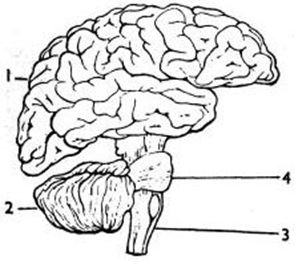
Brain and cranial nerves are the chief parts of the whole nervous system. It is a mass of nervous tissues made up of soft grey and white matter. It occupies the whole of cranium. Cranium is like the iron safe to keep up the treasure ‘brain’. It is surrounded by three membranes or Meninges, viz., (1) dura mater, the fibrous connective tissue by the side of the cranial bones; (2) pia mater, the connective tissue containing a network of blood vessels, which penetrates and nourishes all the parts of the brain; and (3) arachnoid, a very fine membrane around the brain. Below the arachnoid there is the space which contains the cerebro-spinal fluid that is intended to prevent any injury to the brain. The brain looks as if it is floating on this liquid.
The brain is surrounded by three membranes called meninges:
The cerebrospinal fluid protects the brain from injury and allows it to float safely.
It is the anterior, oval-shaped larger part of the brain. It is situated in the upper portion of the cranial cavity. This contains the important centres of hearing, speech, sight, etc. The pineal gland which is regarded as the seat of the soul and which plays a prominent part in Samadhi and psychic phenomena is situated here.
the little or hind brain: This is the main portion of the brain, oblong-shaped, situated just above the fourth ventricle and below and behind the brain. Here the grey matter is arranged over the white matter. It regulates the muscular co-ordination. Mind rests here during dreams.
It is the beginning place of the spinal cord at the cranial cavity, where it is oblong-shaped and wide. It is between the two hemispheres. Here the white matter is placed over the grey matter. This contains the centres of important functions such as circulatory, respiratory, etc. This portion must be carefully protected.
: It is the bridge that lies before the Medulla Oblongata. It is made of white and grey fibres that come from cerebellum and medulla. This is the junction where cerebellum and medulla meet.
“Brahmarandhra” means the hole of Brahman. It is the dwelling house of the human soul. This is also known as “Dasamadvara,” the tenth opening or the tenth door. The hollow place in the crown of the head known as anterior fontanelle in the new-born child is the Brahmarandhra. This is between the two parietal and occipital bones. This portion is very soft in a babe. When the child grows, it gets obliterated by the growth of the bones of the head. Brahma created the physical body and entered (Pravishat) the body to give illumination inside through this Brahmarandhra. In some of the Upanishads, it is stated like that. This is the most important part. It is very suitable for Nirguna Dhyana (abstract meditation). When the Yogi separates himself from the physical body at the time of death, this Brahmarandhra bursts open and Prana comes out through this opening (Kapala Moksha). “A hundred and one are the nerves of the heart. Of them one (Sushumna) has gone out piercing the head; going up through it, one attains immortality” (Kathopanishad).
Sahasrara Chakra is the abode of Lord Siva. This corresponds to Satya Loka. This is situated
at the crown of the head. When Kundalini is united with Lord Siva at the Sahasrara Chakra, the
Yogi enjoys the Supreme Bliss, Parama Ananda. When Kundalini is taken to this centre, the Yogi
attains the superconscious state and the Highest Knowledge. He becomes a Brahmavidvarishtha or
a full-blown Jnani.
The word Sahasradala-Padma denotes that this Padma has 1000 petals. That is, one
thousand Yoga Nadis emanate from this centre. There are different opinions about the exact
number of petals. It is quite sufficient if you know that innumerable Nadis proceed from this centre.
As in the case of other Chakras, the vibrations that are made by the Yoga Nadis are represented by
the Sanskrit letters. All the 50 letters of the Sanskrit alphabet are repeated here again and again on
all Yoga Nadis. This is a Sukshma centre. The corresponding centre in the physical body is in the
brain.
The term “Shat-Chakras” refers only to the chief six Chakras, Muladhara, Svadhishthana, Manipura,
Anahata, Vishuddha and Ajna. Above all these we have Sahasrara Chakra. This is the chief of all the
Chakras. All the Chakras have their intimate connection with this centre. Hence this is not included as
Lalana Chakra is situated at the space just above Ajna and below Sahasrara Chakra. Twelve Yoga Nadis emanate from this centre. The vibrations that are made by the 12 Nadis are represented by the Sanskrit letters: (Ha, Sa, Ksha, Ma, La, Va, Ra, Ya, Ha, Sa, Kha and Phrem). It has OM as its Bija. At this centre the Yogi concentrates on the form of his Guru and obtains all knowledge. This has control over the 12 pairs of nerves that proceed from the brain to the different sense-organs.
“O Devi! Thou art the mind, the sky, the air, the fire, the water, and the earth. Nothing is
outside Thee on Thy transformation. Thou hast become Siva’s consecrated queen to alter Thy own
blissful conscious Form in the shape of the world”.
Kundalini, the serpent power or mystic fire, is the primordial energy or Sakti that lies
dormant or sleeping in the Muladhara Chakra, the centre of the body. It is called the serpentine or
annular power on account of serpentine form. It is an electric fiery occult power, the great pristine
force which underlies all organic and inorganic matter.
Kundalini is the cosmic power in individual bodies. It is not a material force like electricity,
magnetism, centripetal or centrifugal force. It is a spiritual potential Sakti or cosmic power. In
reality it has no form. The Sthula Buddhi and mind have to follow a particular form in the beginning
stage. From this gross form, one can easily, understand the subtle formless Kundalini. Prana,
Ahamkara, Buddhi, Indriyas, mind, five gross elements, nerves are all the products of Kundalini.
One should become perfectly desireless and should be full of Vairagya before attempting to
awaken Kundalini. It can be awakened only when a man rises above Kama, Krodha, Lobha, Moha,
Mada and other impurities. Kundalini can be awakened through rising above desires of the senses.
The Yogi, who has got a pure heart and a mind free from passions and desires will be benefited by
awakening Kundalini. If a man with a lot of impurities in the mind awakens the Sakti by sheer force
through Asanas, Pranayamas and Mudras, he will break his legs and stumble down. He will not be
able to ascend the Yogic ladder. This is the chief reason for people going out of the way or getting
some bodily infirmities. There is nothing wrong in the Yoga. People must have purity first; then a
thorough knowledge of the Sadhana, a proper guide, and a steady, gradual practice. When
Kundalini is awakened there are many temptations on the way, and a Sadhaka without purity will
not have the strength to resist.
A thorough knowledge of the theory is as essential as the practice. Some are of opinion that
theory is not at all necessary. They bring one or two rare instances to prove that Kundalini has been
awakened even in those who do not know anything about Nadis, Chakras and Kundalini. It might be
due to the grace of a Guru or by mere chance. Everyone cannot expect this and neglect the
theoretical side. If you look at the man in whom Kundalini has been awakened through the grace of
a Guru, you will not at once begin to neglect the practical side and actually waste your time in
passing from one Guru to the other. The man who has a clear knowledge of the theory and a steady
practice, attains the desired goal quickly.
Kundalini can be awakened by Pranayama, Asanas and Mudras by Hatha Yogis; by
concentration and training of the mind by Raja Yogis; by devotion and perfect self-surrender by
Bhaktas; by analytical will by the Jnanis; by Mantras by the Tantrikas; and by the grace of the Guru
(Guru Kripa) through touch, sight or mere Sankalpa. Rousing of Kundalini and its union with Siva
at the Sahasrara Chakra effect the state of Samadhi and Mukti. No Samadhi is possible without
awakening the Kundalini. For a selected few, any one of the above methods is quite sufficient to awaken the
Kundalini. Many will have to combine different methods. This is according to the growth and
position of the Sadhakas in the spiritual path. The Guru will find out the real position of the Sadhaka
and will prescribe a proper method that will successfully awaken the Kundalini in a short period.
This is something like the doctor prescribing a proper medicine to a patient to cure a particular
disease. One kind of medicine will not cure the diseases of different patients. So also, one kind of
Sadhana may not suit all.
There are many persons nowadays who foolishly imagine that they have attained purity,
commit errors in selecting some methods and neglect many important items of Sadhana. They are
poor, self-deluded souls. Self-assertive, Rajasic Sadhakas will select some exercises of their own
fancy in an irregular manner and leave all the exercises when they get some serious troubles.
After Kundalini is awakened, Prana passes upwards through Brahma Nadi along with mind
and Agni. You will have to take it up to Sahasrara Chakra through some special exercises such as
Mahabheda, Sakti Chalana, etc.
As soon as it is awakened, it pierces the Muladhara Chakra (Bheda). It should be taken to
Sahasrara through various Chakras. When Kundalini is at one Chakra, intense heat is felt there and
when it leaves that centre for another Chakra, the former Chakra becomes very cold and appears
lifeless.
Freedom from Kama, Krodha, Raga and Dvesha and possession of balance of mind, cosmic
love, astral vision, supreme fearlessness, desirelessness, Siddhis, divine intoxication and spiritual
Ananda are the signs to denote the awakening of Kundalini. When it is at rest, a man has full
consciousness of the world and its surroundings. When it is awakened he is dead to the world. He
has no body-consciousness. He attains Unmani state. When Kundalini travels from Chakra to
Chakra, layer after layer of the mind becomes opened and the Yogi acquires psychic powers. He
gets control over the five elements. When it reaches the Sahasrara Chakra, he is in the Chidakasa
(knowledge space).
Awakening of the Kundalini Sakti, its union with Siva, enjoying the nectar and other
functions of the Kundalini Yoga that are described in the Yoga Sastras are misrepresented and
taken in a literal sense by many. They think that they are Siva and ladies to be Sakti and that mere
sexual union is the aim of Kundalini Yoga. After having some wrong interpretation of the Yogic
texts, they begin to offer flowers and worship their wives with lustful propensities. The term
“Divine intoxication that is derived by drinking the nectar” is also misrepresented. They take a lot
of wine and other intoxicating drinks and imagine to have enjoyed the Divine ecstasy. It is mere
ignorance. They are utterly wrong. This sort of worship and union is not at all Kundalini Yoga.
They divert their concentration on sexual centres and ruin themselves. Some foolish young boys
practise one or two Asanas, Mudras and a little Pranaya ma too for a few days, in any way they like,
and imagine that the Kundalini has gone up to their neck. They pose as big Yogis. They are pitiable,
self-deluded souls. Even a Vedanti (a student of Jnana Yoga) can get Jnana Nishtha only through
awakening of the Kundalini Sakti that lies dormant at the Muladhara Chakra. No superconscious state or Samadhi is possible without awakening this primordial energy, whether it is Raja Yoga, Bhakti Yoga, Hatha Yoga or Jnana Yoga.
It is easy to awaken the Kundalini, but it is very difficult to take it to Sahasrara Chakra
through the different Chakras. It demands a great deal of patience, perseverance, purity and steady practice. The Yogi who has taken it to Sahasrara Chakra, is the real master of all forces. Generally Yogic students stop their Sadhana half-way on account of false Tushti (satisfaction).
They imagine that they have reached the goal when they get some mystic experiences and psychic powers. They desire to demonstrate such powers to the public to get Khyati (reputation and fame) and to earn some money. This is a sad mistake. Full realisation alone can give the final liberation, perfect peace and Highest Bliss.
Different methods of awakening the Kundalini by Hatha Yoga, Bhakti Yoga, Raja Yoga
and Jnana Yoga will be described one by one. Some aspirants will not get perfection by only one
method. A harmonious combination of all methods is necessary for the vast majority of persons.
In the following pages I will tell you the different exercises that are intended to awaken the Kundalini.If you are wise enough, after a perusal of the different exercises, you can easily pick up the right method of Sadhana that suits you best and attain success.
Rousing of Kundalini and its union with Siva at the Sahasrara Chakra effect the state of
Samadhi and Mukti. Before awakening the Kundalini, you must have Deha Suddhi (purity of body), Nadi Suddhi (purification of Nadis), Manas-Suddhi (purity of mind) and Buddhi Suddhi
(purity of intellect). For the purification of the body, the following six exercises are prescribed:
Dhauti, Basti, Neti, Nauli, Tratak and Kapalabhati. These are known as Shat-Karma or the
six purificatory exercises in Hatha Yoga.