
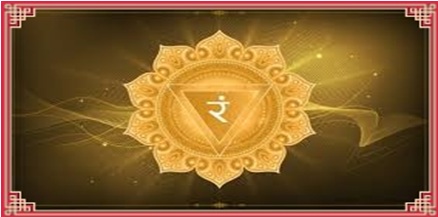
Solar plexus is often called the abdominal brain. It is an important centre of nerves connected with the sympathetic nervous system. It is located in the epigastric region behind the pit of the stomach. It controls the main internal organs and plays an important role in emotions and bodily functions.
It is the storehouse of Prana and the powerhouse of the nervous system. When Prana and thoughts are directed to this centre through Pranayama, it awakens latent energy and radiates strength throughout the body.
Sit in Padmasana or Siddhasana. Close your eyes. Inhale slowly through the left nostril while mentally repeating OM. Retain the breath and concentrate on the solar plexus. Imagine strength, joy and vitality entering your body. Exhale slowly through the right nostril.
Repeat this process 12 times. Fear, depression and weakness will disappear. Confidence and spiritual strength will increase.
There are five elements, viz., Prithvi, Apas, Agni, Vayu and Akasa. To the body of the five elements, there is the fivefold Dharana. From the feet to the knees is said to be the region of the Prithvi. It is four-sided in shape, yellow in colour and has its Varma the Sanskrit letter ‘L’ along the region of earth i.e. from the feel to the knees. Contemplating upon this, one should perform Dharana there for a period of two hours daily. He then attains mastery over the earth. Death does not trouble him since he has obtained mastery over the ‘earth’ element.
The region of Apas is said to extend from the kness to the anus. Apas is semi-lunar in shape and white in colour. It has the letter ‘Va’ for its Bijakshara-seed-letter.
Carrying up the breath with the letter ‘Va’ along the region of Apas, one should contemplate on God Narayana, having four arms, a crow need head, dressed in orange-colour clothes and as secayless. Practicing Dharana there daily for a period of two hours, he is freed from all sins. Then there is no fear for him from water.
From the anus to the heart is said to be the region of Agni is triangular in shape red in colour and has the letter ‘Ra’ for its Bija. Raising the breath with the letter ‘Ra’ along the region of fire, one should contemplate on Rudra, who has three eyes, who grants all wishes and who is of the colour of midday sun. Practising Dharana there daily for a period of two hours, he is not burnt by fire, even thought his body enters into the fire-pit.
From the heart to the middle of the eyebrows is said to be the region of Vayu. It is black in colour and shine with the letter ‘Ya’. Carrying the breath along the region of Vayu, one should contemplate on Ishvara, the omniscient. The Yogi does not meet his death through Vayu.
From the centre of the eyebrows to the top of the head is said to be the region of Akasa. It is circular in shape, smoky in colour and shines with the letter ‘Ha’. Raising the breath along the region of Akasa, one should contemplate on Sadasiva. By practising this Dharana one obtains the powers of levitation. The Yogi gets all the Siddhis.
Bhusunda is one of the “Chiranjivis” amongst the Yogins. He was the master of the science of Pranayama. It is said that a big nest, like that of mountain, was built by him on the southern branch of the Kalpa Vriksha, situated at the northern summit of the “Mahameru.” In this nest, there lived the crow, Bhusunda, by name. This crow, Bhusunda, is said to be the longest lived Yogi. He was a “Trikala Jnani.” He could cognise all the three periods of time. He could sit in Yoga (Samadhi) for any length of time. He was desirelss. He had obtained supreme Santi and Jnana. He had obtained supreme Santi and Janana. He was there, enjoying the bliss of his own Self and he is there still, being a Chiranjivi. He was for a log time engaged in the worship of Brahmashakti “Alambusa”/ At this spot of the Kalpa Vriksha, Bhusunda lived for many Yugas, nay for many Kalapas. He would quit his nest at the time of Pralaya. He had the full Knowledge of the five Dharanas. He had rendered proof of himself against the five elements, by practising the five methods of concentration.
It is said that when all the twelve Adityas scorch world with their burning rays, he would through his ‘Apas Dharana’ (water) reach up the Akasa. When the fierce gales arise splintering up the rocks to pieces, he would be in the Akasa, through Agni Dharana. When the world together with its Mahameru would be under water, he would float on them without any flutcation through ‘Vayu Dharana, and when the time of universal destruction arrived, he would be, as in Sushupti, in the Brahmic seat till the beginning of another creation of Brahma. After this creation, he would again resort to the said nest for his abode. The Kalpa Vrisha, at the summit of the mountain, through his Sankalpa (will-power) would arise and grow up in the similar way, at the beginning of the next Kalpa, every time.
The food that you take consists of nitrogenous elements and proteins, fats or hydrocarbons such as ghee and carbohydrates such as rice and sugar proteins build up the tissues and muscles. Carbohydrates produce energy. Besides these, there are various kinds of salts also. The various digestive juices, saliva in the mouth, gastric juice in the stomach, bile, pancreatic juice and the Succusenterious or the intestinal juice in the intestines act upon the particles of food during their passage in the alimentary canal or digestive tube. Saliva acts upon starch. It converts it into sugar. This action is further taken by pancreatic and intestinal juices, in the intestines. Bile acts upon fats. Gastric juice and pancreatic juice act upon protiens. The whole thing is converted into a milky juice called chyle. This chyle is absorbed by lacteal vessels and it is mixed with blood. This impure blood is sent to the lungs for purification and after being purified is brought back to the left side of the heart, and from there it is pumped through the big artery aorta, throughout the body. In the capillaries the blood exudes as lymph and bathes and nourishes the tissues and cells of the body, and the impure blood is carried back by veins to the right side of the heart.
The waste products of food are carried along the large intestine which is six feet in length to the rectum where it is retained as faecal matter. When the nervous impulse is carried to the rectum from the defaecation centre in the spinal cord, it is discharged in the morning through the anus, the terminal opening of the alimentary canal. The kidneys, that are situated in the loins, on each side, eliminate the urine from the blood and send it through two tubes called the ureters to the reservoir of urine called ‘bladder’. From the bladder it is discharged through the urethra
The nervous system consists of cerebrum or forebrain, cerebellum or hind brain, spinal cord and the sympathetic nerves. There are various centers in the brain for hearing, seeing, tasting, smelling, speaking etc. the different impulse from the hands when a finger is stung by a scorpion, are carried through the sensory nerves to the spinal cord from the spinal cord to brain. Mind that has taken its seat in the brain reacts. It feels. An impulse travels from the spinal cord and thence along the motor nerves to the hand. At once the hand is taken back from the scorpion. This is all done in the twinkling of an eye. The sympathetic nerves supply the internal organs of the abdomen, liver, spleen, heart, etc.
Now I will describe how this vital fluid semen is manufactured. The two testes or seeds that are located in the scrotal bag are called secretary glands. These cells of the testes have been endowed with the peculiar property of secreting semen drop by drop from the blood, just as the bees collect honey in the honey comb. Then this fluid is taken by the two spermatic ducts or tubes to the two small bags or reservoirs for the semen called Vesicular Seminal is (seminal bags), one on each side. Under excitement it is thrown out by small ducts called ejaculatory ducts into the portic portion of urethra or urinary canal, where it is mixed with the prostatic juice, secreted by the prostate glands. Who is the real Director of these internal, organs? Who has created this subtle, internal, magnanimous machinery? Are you not struck with awe and wonder, my dear friends, when you think for a moment seriously about the Divine Gradeur and Divine Glory, that are inhibited in the structure of these miraculous mechanisms, heart, lungs, brain etc? How harmoniously do they work! Who converts food into blood? Who pumps the blood into the arteries? It is He. Feel His indwelling presence. Pay your silent homage to Him. Glory, Glory, up to the Lord, the Creator of this wonderful body, His own image, His own dwelling house, the Navadvarapuri, the nine-gated city!
A diet that is conducive to the practice of Yoga and spiritual progress can be rightly termed “Yogic Diet”. Diet has intimate connection with the mind. The mind is formed out of the subtlest portion of food. Saga Uddalaka instructs his son Svetaketu as follows: “Food when consumed becomes threefold, the gross particles become excreta, the middling once flesh, and the fine once the mind.” Again you will find in the Chhandogya Upanishad: “By the purity of food one becomes purifies in his nature; by the purification of his nature he verily gets memory of the Self, and by the attainment of the memory of the Self, all ties and attachments are severed.”
Diet is of three kinds’ viz., sattvic diet, Rajasic diet and Tamasic diet. Milk fruits, cereals, butter, cheese, tomatoes, spinach are Sattvic food-stuffs. They render the mind pure. Fish, eggs, meat, etc., are Rajasic food-stuffs. They excite the passionate nature of man. Beef, onions, garlic, etc., are Tamasic food-stuffs. They fill the mind with inertia and anger. Lord Krishna says to Arjuna in Gita: The food which is dear to each is threefold. Hear thou the distinction of these. The foods which increase vitality, energy, vigour, health and joy and which are delicious, bland, substantial and agreeable are dear to the pure. The passionate man desires foods that are bitter, sour, saline, excessively hot, pungent, and dry and burning and which produce pain, grief and disease. The food which is stale, tasteless, putrid, rotten and impure is dear to the Tamasic.”
The diet should be such as can maintain physical efficiency and good health. The well-being of a man depends rather on perfect nutrition than on anything else. Various sorts of intestinal disease, increased susceptibility to infectious diseases, lack of high vitality and power of resistance, rickets, scurvy, anaemia or poverty of blood, beriberi, etc., are all due to faulty nurtition. It should be remembered that it is not so much the climate, as food which plays a vital in producing a healthy strong man or a weakling suffering from a host of diseases. Knowledge of the science of dietetics is essential for every man if he wants to keep up physical efficiency and good health. He should be able to make out a cheap, well-balanced diet from certain articles of diet then only all the members of his family will be hale and hearty. What is wanted is a well-balanced diet but not a rich one. A rich diet produces diseases of the liver, kidney, and pancreas. A well-balanced diet helps a man to grow, and turn out much work, increases his body weight and keeps up the efficiency and a high standard of vigour and vitality. A man is what he eats. This is a truism indeed.
Food is required for two purposes. (1) To maintain our body-heat and to produce new cells and to make up for the wear and tear of our bodies. Foodstuffs contain proteins, carbohydrates, hydrocarbons, phosphates, salt, various kinds of ashes, water, vitamins, etc. Protein substances are nitrogenous. They build the tissues of the body. They are present in abundance in dhal, milk, etc. They are called “tissue-builders”. Proteins are complex orangic compounds which contain carbon, hydrogen, oxygen and nitrogen and sometimes sulphur, phosphorous and iron. Starches are carbohydrates. They are present in abundance in rice. Carbohydrates are “energy-producers” or heat-givers. Carbohydrates are substances, like starch, sugar or gum and contain carbon, hydrogen and oxygen. Hydrocarbons or fats are present in ghee and vegetable oils. Fats are compounds of glycerin with fatty acids. The human machine of the body necessarily needs lubrication. Butter, cream, cheese, olive-oil, groundnut-oil, mustard-oil are good for lubrication.
A well-balanced diet is one in which the diffe3rent principles of diet that go to keep the body and mind in perfect health and harmony exist in proper proportions. Milk is perfect food, because it contains all nutritious principles in proper well-balanced proportions. The protein, fat and carbohydrate should be in right proportion. They should be of the right kind also. If a diet contains too much of one way or the other by being deficient or preponderating in one or more important constituents of food, then it is called an ill balanced or faulty diet. This will lead to malnutrition, stunted growth, physical deficiency, etc. Many diseases take their origin from malnutrition, If the food is nutritious, wholesome and well-balanced, one has good power of endurance and physical efficiency. If he has physical efficiency he can turn out more work. Some take milk as an animal diet, while some others regard egg as vegetable diet. All these people are under a delusion. Milk is a vegetable diet, while egg is an animal diet. This is the emphatic declaration of learned sages. Yogic students should give up eggs. All the nutritive principles are found in milk, butter, cheese, fruits, almonds, tomatoes, carrots and turnips.
The important digestive juices are saliva in the mouth, gastric juice in the stomach pancreatic juice, bile and intestinal juice (succus entericus) in the small intestines saliva in alkaline. It is secreted by the salivary glands.
It digests starches. Gastric juice is acidic in reaction. It contains hydrochloric acid. It is secreted by the gastric glands. It digests proteins. Pancreatic juice digests starches, proteins and fats. It contains three kinds of digestive ferments. It is manufactured by the pancreas. Bile is secreted by the liver. It digests fats. The food-stuffs are rendered into chyle by the action of these digestive juices, which is absorbed by the lacteals of the small intestines.
Gluttons and epicureans cannot dream to get success in Yoga. He who takes moderate diet, he who has regulated his diet can become a Yogi. That is the reason why Lord Krishna says to Arjuna: “Verily Yoga is not for him who eat too much, nor who abstained to excess nor who is too much addicted to sleep, nor even to wakefulness, Arjuna. Yoga killed out all pain for him who is regulated in eating and amusement, regulated in performing actions, regulated in sleeping and waking Take pleasant, wholesome and sweet food half-stomach, fill the quarter-stomach with pure water and allow the remaining quarter free for expansion of gas. This is moderate diet.
All articles that are putrid, stale, decomposed, fermented, unclean, twice-cooked, kept overnight should be abandoned. The diet should be simple, light, bland, wholesome, easily digestible and nutritious. He who lives to eat is a sinner but he who eats to live is a saint. The latter should be adored. If there is hunger, food can be digested well. if you have no appetite do not take anything, give rest to the stomach.
A good quantity of food overworks the stomach, induces capricious appetite and renders the tongue fastidious. Then it becomes very difficult to please the tongue. Man has invented many kinds of dishes just to satisfy his palate and has made his life very complex and miserable. He calls himself a civilized and cultured man when he is really ignorant and deluded by the senses. His mind gets upset when he cannot get his usual dishes in a new place. Is this real strength? He has become an absolute slave of his tongue. This is bad. Be natural and simple in eating. Eat to live and do not live to eat. You can be really happy and can devote much time to Yogic practices.
A Yogic student who spends his time in pure meditation only, wants very little food. One or one and a half seer of milk and some fruits will suffice. But when he comes on the platform for work he wants abundant nutritious food. A man who does immense labour (physical work) wants more food.
Meat is not at all necessary for the keeping up of health. Meat-eating is highly deleterious to health. It brings a host of ailments such as tape-worm, albuminuria and other diseases of the kidneys. After all, man wants very little on this earth. Killing of animals for food is a great sin. Instead of killing the egoism and the idea of “mine-ness” ignorant people kill innocent animals under the pretext of sacrifice to Goddess but it is really to satisfy their tongues and palates. Horrible! Most inhuman! “Ahimsa Paramo Dharmah”. Ahimsa is the first virtue that a spiritual aspirant should possess.” We should have reverence for life. Lord Jesus says: “Blessed are the merciful, for they shall obtain mercy.” Lord Jesus and Mahavir shoulted at the top of their voice: “Regard every living being as you and harm no one.” The law of Karma is inexorable, unrelenting and immutable. The pain you inflect upon another will rebound upon you and the happiness you radiate to another will come back to you, adding to your happiness.
Dr. J. Oldfield, Senior Physician, Lady Margaret Hospital, writes: “Today there is the chemical fact in the hands of all, which none can gainsay that the products of the vegetable kingdom contain all that is necessary for the fullest sustenance of human life. Flesh is an unnatural food, and therefore, tends to create functional disturbances. As it is taken in modern civilisation, it is infected with such terrible diseases (readily transferable to man), as cancer, consumption, fever, intestinal worms, etc., to an enormous extent. There is little need for wonder that flesh-eating is one of the most serious causes of the diseases that carry off ninety-nine out of every hundred people that are born.”
Meat-eating and alcoholism are closely allied. The craving for liquor dies a natural death when the meat diet is withdrawn. The question of birth-control becomes very difficult in the case of those who take meat-diet. To them mind-control is absolutely impossible. Mark how the meat-eating tiger is ferocious, and the cows, elephant, which live on vegetable matter, are mild and peaceful! Meat has a direct evil influence on the compartments of the brain. The first step in the spiritual advancement is the giving up of meat-diet. In large meat-eating countries cancer mortality is very high. Vegetarians keep up the sound health till old age. Even in the West in the Hospitals, doctors are now putting patients on vegetable diet. They convalesce very quickly.
Pythagoras, the Grecian Sage, condemned meat diet as sinful food! Just hear what he says. “Beware, O mortals, of defiling your bodies with sinful food! There are cereals, there are fruits bending the branches down by their weight, and luxurious grapes on the vines. There are sweet vegetables and herbs, which, the flame, digestive fire, can render palatable and mellow. Nor are you denied neither milk nor fragrance of the aroma of the thyme flower, the bountiful earth offers you an abundance of pure food and provides for meals obtainable without slaughter and bloodshed.”
If you want to stop taking mutton, fish, etc., just see with your own eyes the pitiable, struggling condition at the time of killing sheep. Now mercy and sympathy will arise in your heart. Then you will determine to give up flesh-eating. If you fail in this attempt, just change your environments and live in a vegetarian hotel where you cannot get mutton and fish. Move in that society where there is only vegetable diet. Always think of the evils of flesh-eating and the benefits of a vegetable diet. If this also cannot give you sufficient strength to stop this habit, go to the slaughter house and butcher’s stop and personally see the disgusting rotten muscles, intestines, kidneys and other nasty parts of the animal, which emit bad smell. This will induce Vairagya in you and a strong disgust and hatred towards meat-eating.
It is not only heinous but an atrocious crime you kill a cow or a goat which gives invaluable milk, butter, etc. O self! Deluded ignorant cruel man! Do not kill these innocent beings. Terrible torture awaits you on the day of judgment.
You are morally responsible for all your acts. The law of Karma is infallible. Killing of cows tantamounts to killing one’s own mother. What right have you got to take away the lives of these innocent animals which give you milk to nourish your body? This is a most brutal, inhuman, heartrending etc. The slaughter of cows, goats and other animals should be immediately stopped by legislation. The animal that is taken for slaughter causes various sorts of poisons in the blood on account of its fear and anger. The vegetarian diet can fully supply the dietetic needs of the body. Therefore, such cruelties are unwarranted.
I shall speak a word now on vitamins. Vitamins are also required in the diet. They build the bodies. If they are absent or deficient, the body cannot grow and deficiency diseases such as rickets, scurvy etc. result. They are present in very small quantities in foods. They are like a spark which ignites the fire of nutrition. There are four important kinds of vitamins:- Vitamin A, Vitamin B, Vitamin C and Vitamin D. Vitamin A is present in milk. Vitamin B is present in the unpolised rice and tomato juice. Deficiency of Vitamin V causes beriberi. Those who eat polished rice get this disease. Vitamin C is found in vegetables, fruits and green leaves. This vitamin is destroyed by cooking, tanning. Sailors suffer from scurvy, because long cannot get fresh vegetables and fruits during long voyage. They generally take with them the juice of lemons. This prevents the development of scurvy. Vitamin D is present in milk, butter, eggs, cod-liver oil, etc. absence or deficiency of Vitamin D cause rickets in children.
Food is nothing but a mass of energy. Food supplies energy to the body and mind. If you can draw this energy from your pure will, if you know the Yogic technique of absorbing the energy directly from the Sun or cosmic Prana, you can maintain the body with this energy and can dispence with food altogether. The Yogi gets Kayasiddhi or perfection of the body.. If food is completely digestible it will produce constipation. Food should contain some residue of fibbers or husks which will form faecal matter. No water should be taken when digestion is going on in the stomach. It will dilute the digestive juice and impair digestion. You can take a glassful of water when you have finished your meals.
Where can Sannyasins who live on public alms get a well-balanced diet? They get some day’s pungent stuffs only, on some other days sweetmeats only, on some other day’s sour things only. But they draw the required energy through the power of meditation. This unique, Yogic method is unknown to the medical profession and scientists. Whenever the mind is concentrated, a divine wave bathes all the tissues with the divine elixir. All the cells are renovated and vivified.
Fasting is interdicted for practitioners of Yoga as it produces weakness. Occasional mild fast is highly beneficial. It will thoroughly overhaul the system, will give rest to the stomach and intestines and eliminate uric acid. Yogic students can take one full meal at 11 O’ clock a cup of milk in the morning and half a seer of milk and 2 bananas or two oranges or 2 apples at night. The night meals should be very light. If the stomach is loaded, sleep will supervene. A diet consisting of milk and fruits alone is a splendid menu for students of Yoga. Simple, natural, non-stimulating, tissue-building, energy.-producing, non-alcoholic foods and drinks keep the mind calm and pure and help one in Yogic prac¬tices and in the attainment of the goal of life