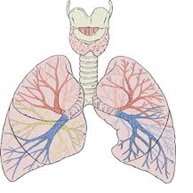
It will not be out of place here to mention a word on lungs and their functions. The organs of respiration consist of two lungs, one on either side of the chest and the air passages that lead to them. They are located in the upper thoracic cavity of the chest, one on each side of the median line. They are separated from each other by the heart, the greater blood vessels and the larger air-tubes. The lungs are spongy, porous and their tissues are very elastic. The substance of the longs contains innumerable air - sacs, which contain air. After post – mortem, when it is placed, in a basin of water, it floats. They are covered by a delicate serious membrane called the pleura which contains serious fluid to prevent friction of the lungs, during the act of breathing. One wall of he pleura closely adheres to the lungs. The other wall is attached, to the inner wall of the chest. Through this membrane the lungs are fixed to the wall of the chest. The right lung consists of three lobes. The left lung contains two lobes. Each lung consists of an apex and a base. The base is directed towards the diaphragm, the muscular septum, the dividing wall between throat and abdomen. The apex is situated above, near the root of the neck. Its is the base that gets inflamed in Pneumonia. The aped of the lung which does not get proper supply of oxygen gets affected by consumption. It affords favorable nadis or breeding ground for Tubercle Bacilli (T. B.). by the practice of Kapalabhati and Bhastrika Pranayams and deep breathing exercises, these apices get good supply of oxygen and thus phthisis is obviated. Pranayama will have a powerful, sweet, melodious voice.
The air – passage consists of the interior of the nose, pharynx or throat, larynx or the wind box, or sounding box, which contains two vocal cords, trachea or windpipe: right and left bronchi and the smaller bronchial tubes. When we breathe, we draw in the air through the nose and after it has passed through the pharynx and larynx, it passes into the trachea or windpipe, thence into the right and left bronchial tubes, which in turn, subdivide into innumerable smaller tubes called bronchioles, and which terminated in minute subdivisions in the small air-sacs of the lungs, of which the lungs contain millions. The air – sacs of the lungs when spread out over an unbroken surface, would cover an area of 1, 40,000 square feet.
The air is drawn into the lungs by the action of the diaphragm. When it expands, the size of the chest and lungs is increased and the outside air rushes into the vacum thus created. The chest and lungs contract, when diaphragm relaxes and the air is expelled from the lungs.
It is through vocal cords that are located in the larynx that sound is produced. Larynx is the sounding box. When the vocal cords are affected by too much straining, as in singing and continuous lecturing, the voice becomes hoarse. In females these cords are shorter. Hence they have a sweet melodious voice.
The number of respiration per minute is 16. In Pneumonia it is increased to 60, 70, and 80 per minute. In Asthma, the bronchial tubes become spasmodic and they contract. Hence there is difficulty in breathing. Pranayama removes the spasm or constriction of these tubes. A small membranous flat cap covers the upper surface of larynx. It is called Epiglottis. It prevents the food-particles or water from entering into the respiratory passage. It acts the part of a safety value.
When a small particle of food tries to enter the respiratory passage, cough comes in and the particle is thrown out.
Large purify the blood. The blood starts on its arterial journey, bright-red and rich-laden with life-giving qualities and properties. It returns by the venous route, poor, blue-laden with the waste matter of the system. Arteries are tubes or vessels that carry pure oxygenated blood from the heart towards the different parts of the body. Veins are vessels or tubes that carry back impure blood from the different parts of the body. The right side of the heart contains impure venous blood. From the right side of the heart the impure blood goes to the lungs, for purification. It is distributed among the millions of tiny air-cells of the lungs. A breath of air is inhaled and the oxygen of the air comes in contact with the impure blood through the thin walls of the hair-like blood-vessels of the lugs called pulmonary capillaries. The walls of the capillaries are very thin. They are like muslin cloth or sieve. Blood oozes out or exudes readily. Oxygen penetrates through the walls of these thin capillaries. When the oxygen comes in contract with the tissues a form of combustion takes place.
The blood takes up oxygen and releases carbonic acid gas generated from the waste products and poisonous matter, which has been gathered up by the blood from all parts of the system. The purify blood is carried by the four pulmonary veins to the left auricle and thence to the left ventricle. From the ventricle it is pumped into the biggest artery, aorta, from aorta, is passes into the different arte pints of body. It is estimated that in a day 35,000 pints of blood traverses the capillaries of the lungs for purification.
From the arteries the pure blood goes into the thin capillaries. From the capillaries the lymph of the blood exudes, bathes and nourishes the tissues of the body. Tissue respiration takes place in the tissues. Tissues take up the oxygen and leave the carbon dioxide. The impurities are taken by the veins to the right side of the heart.
Who is the creator of the delicate structure? Are you feeling the invisible hand of God behind these organs? The structure of this body bespeaks undoubtedly of the omniscience of the Lord. The Antaryamin or the Indweller of our hearts supervises the working of the
inner factory as Drashta. Without His presence, heart cannot pump blood into the arteries. Lungs cannot carry out the process of purifying the blood. Pray. Pay your silent homage to Him. Remember Him at all times. Feel His presence in all cells of the body.
There are the two nerve-currents one on either side of the spinal column. The left one is called Ida and the right is known as Pingala. These are Nadis. Tentatively, some take these as the right and the left sympathetic cords, but they are subtle tubes that carry Prana. The Moon moves in the Ida and the Sun in the Pingala. Ida is cooling. Pingala is heating. Ida flows through the left nostril and the Pingala through the right nostril. The breath flows through the right nostril for one hour and then through the left nostril for one hour. Man is busily engaged in worldly activities, when the breath flows through Ida and Pingala. When Sushumna operates, he becomes dead to the world, and enters into Samadhi. A Yogi tries his level best to make the Prana run in the Sushumna Nadi, which is known as the central Brahma Nadi also. On the left of Sushumna is situated Ida and on the right is Pingala. The moon is of the nature of Tamas and the sun is that of the Rajas. The poison share is of the sun and the nectar is of the moon. Ida and Pingala indicate time. Sushumna is the consumer of time.
Ida is cooling. Pingala is heating.
Sushuman is the most important of all the Nadis. It is the sustainer of the universe and the path of universe and the path of salvation. Situated at the back of the anus, it is attached to the spinal column and extends to the Brahmarandhra of the head and is invisible and subtle. The real work of a Yogi begins when Sushumna begins to function. Sushumna runs along the centre of the spinal cord or spinal column. Above the genital organs and below the navel is the Kanda, of the shape of a bird’s egg. There arises from it all the Nadis 72,000 in number. Of these, seventy-two are common and generally known. Or these chief ones are ten and they carry the Pranas. Ida, Pingala, Sushumna, Gandhari, Hastijihva, Pusa, Yusasvini, Alambusa, Kuhuh and Sankhini are said to be the ten important Nadis. The Yogis should have Moon, Sun and Agni as their Devatas. When Prana moves in Sushumna: sit for meditation. You will have deep Dhyana. If the coiled-up energy, Kundalini, passes up along the Sushumna Nadi and is taken up from Chakra to Chakra, the Yogi gets different sorts of experiences, powers and Ananda.
It leads to spiritual awakening.
Kundalini is the serpent power or sleeping Sakti,, that has 3 ½ coils with face downwards, in the Muladhara Charkra, at the base of the spine. No Samadhi is possible without its being awakened. The practice of Kumbhaka in Pranayama produced heat and thereby Kundalini is awakened and posses upwards along the Sushumna Nadi. The Yogic practitioner experiences various visions. Then the Kundalini passes along the six Chakras and eventually gets united with Lord Siva, seated on the Sahasrara or thousand petalled lotuses, at the crown of the head. Nirvikalpa Samadhi ensues now and the Yogi gets liberation and all the divine Aisvarays. One should practise control of breath with concentration of mind. The awakened Kundalini that is taken up to Manipura Chakra may drop down again to Muladhra. It has to be raised up again with effort. One should become perfectly desireless and should be full of Vairagya before he attempts to awaken Kundalini. Kundalini is like a thread and is resplendent. When it is awakened it hisses like a serpent beaten with a stick and enters the hole of Sushumana. When it travels from Chakra to Chakra, layer after layer of the mind becomes open and the Yogi acquires various Siddhis (psychic powers).
Pranayama awakens Kundalini.
Chakras are centres of spiritual of spiritual energy. They are located in the astral body, but they have corresponding centres in the physical body also. They can hardly be seen by the naked eyes. Only a clairvoyant can see with his astral eyes. Only a clairvoyant can see with his astral eyes. Tentatively they correspond to certain plexuses in the physical body. There are six important Chakras. They are: - Muladhara, containing (4 petals) at the anus; Svadhishthana (6 petals) at the genital organ; Manipura (10 petals) at naval; Anahata (12 petals) at the heart; Vishuddha (16 petals) at the throat and Ajna (2 petals) at the space between the two eyebrows. The seventh Chakra is known as Sahasrara, which contains a thoural plexus tentatively corresponds to Muladhara Chakra; Prostatic plexus to Svadhishthana, Solar plexus to Manipura, Cardiac plexus to Anahata Chakra, Laryngal plecus to Vishuddha Chakra and Cavernous plexus to Ajna Chakra.
Nadis are astral tubes made up of astral matter that carry Pranic currents. They can be seen by the astral eyes only. They are not the nerves. They are 72,000 in number. Ida, Pingala and Sushumna are the important ones. Sushumna is the most important of all.
Pranayama is said to be the union of Prana and Apana. It is of three kinds-expiration, inspiration and retention. They are associated with the letters of the Sanskrit alphabet for the right performance Pranayama. Pranava only is said to be Pranayama. Sitting in Padmasana (Lotus-posture) the person should meditate that there is, at the tip of his nose, Devi Gayatri, a girl of red complexion, surrounded by numberless rays of the image of the moon and mounted on Hamsa (Swan) having a mace in her hand. She is the visible symbol of the letter A. The letter U has as its visible symbol Savitri, a young lady of white colour having a disc in her hand, ridding on an eagle (Garuda). The letter M has as its visible symbol Sarasvati, an aged woman of black colour, ridding on a bull, having a trident in her hand. He should meditate that the single letter, the supreme light-the Pranava OM is the origin or source of these letters – and Drawing up the air through Ida (left nostril) for the space of 16 Matras, he should meditate on the letter A during that time; retaining the inspired air for the space of 64 Matras he should meditate on the letter U, during that time; he should then exhale the inspired air for the space of 32 Matras, meditating on the letter M during that time. He should practise thus in the above order again and again. Having become firm in the posture and having preserved perfect self-control, the Yogi should, in order to clear away the impurities of the Sushumna, sit in Padmasana, and having inhaled the air through the left nostril, should retain it as long as he can and should exhale through the right. Then drawing it again through the right and having retained it, he should exhale it through the left, in the order, that he should draw it through the same nostril, by which he exhaled it before and had retained it. To those who practise according to these rules, through the right and left nostrils, the Nadis becomes purified within three months. He should practise cessation of breath at sunrise, at midday, at sunset, at midday, at sunset and at midnight, slowly, 80 times a day, for 4 weeks. In the early stage, perspiration is produced; in the last stage, levitation in the air. These results ensue out of the repression of the breath, while sitting in the Padma posture. When perspiration arises with effort, one should rub his body well. By this, the body becomes firm and light. In the early course of practice, food with milk and ghee is excellent. One sticking to this rule, becomes firm in his practice and gets no Taapa (burning sensation) in the body. As lions, elephants and tigers are gradually tamed, so also the breath, when rigidly managed, comes under control. By the practice of Pranayama, the purification of the Nadis, the brightening of the gastric fire, hearing distinctly of spiritual sounds and good health result. When the nervous centres have become purified through the regular practice of Pranayama, the air easily forces its way up through the month of the Sushumna, which is in the middle. By the contraction of the muscles of the neck and by the contraction of the one below viz., Apana, the Prana goes into the Sushumna Nadi is between Ida and Pingala. The Prana which alternates ordinarily between Ida and Pingala, is restrained by long Kumbhaka; then along with the soul, its attendant, it will enter the Sushumna, the central Nadi, at one of three places where it yields space for entrance through such restraint of breath, and in the west. After such entry it is that the Yogi becomes dead to the world, being in that state called Samadhi. Drawing up the Apana and forcing down the Prana from the throat, the Yogi free from the throat, the Yogi free from old age, becomes a youth of sixteen. Through the practice, Homeopathic, Ayurvedic and Unani doctors will be rooted out.
Those who are of a flabby and phlegmatic constitution only, should practise at first these six Kriyas to prepare themselves for the practice of Pranayama and their success comes in easily. These six Kriyas are: 1. Dhauti, 2.Basti 3. Neti, 4. Trataks, 5.Nauli and 6. Kapalabhati.
Dhauti :
Take a clean piece of muslin cloth 4 fingers wide and 15, feet long. Dip it in tepid water. The borders of the cloth should be nicely stitched on all sided and no pieced of thread should be hanging loose. Then slowly swallow it and draw it out again. Swallow one foot the first day and increase it daily, little by little. This is called Vastra-dhauti. In the beginning you many have slight retching. It stops on the third day. This practice cures diseases of the stomach, such as gastritis, Gulma (dyspepsia), belching, fever, lumbago, asthma, Pleeha (diseases of spleen), leprosy, skin-diseases and disorders of phlegm and bile. You need not practise it daily. You can practise it once a week or once in a fortnight. Wash the cloth with soap and keep it always clean. Drink a cup of milk after the practice is over; otherwise, you will feel a dry sensation inside.
Basti :
This can be practised with or without a bamboo tube. But it is better to have a bamboo-tube. Sit in a tub of water covering your navel. Assume the posture Utkatasana by resting your body on the forepart of your feet, the heels pressing against the posteriors. Take a small bamboo-tube, 6 fingers long and insert 4 fingers of its length into the anus after lubricating the tube with vaseline or soap or castor oil. Then contract the anus. Draw the water into the bowels slowly. Shake well the water within the bowels and then expel the water outside. It is known as jala-Basti. It cures Pleeha, urinary disorders, Gulma, myalgia, disorders of digestion, diseases of the spleen and bowels, diseases arising from the excess of wind, bile and phlegm. This Kriya should be done in the morning when the stomach is empty. Drink a cup of milk or take your meals when the Kriya is over. This Kriya can be practiced while standing in a river.
Neti :
Take a thin thread 12 fingers long ( ½ cubit) without knots. Insert it into the nostrils and passing it inside draw it out by the mouth. You can also pass the thread through one nostril and pull it through the other. The thread is glued and thereby rendered stiff for passing through easily. This Kriya purifies the skull and produces clear and keen sight. Rhinitis and Coryza are cured thereby.
Trataka :
Gaze steadily without winking with a concentrated mind at any small object, until tears begin to flow. By this practice all diseases of the eye are removed. Unsteadiness of the mind vanishes. Sambhavi Siddhi is obtained. Will-power is developed. Clairvoyance is induced.
Nauli :
This is abdominal churning with the help of rectum muscle of the abdomen. Bend the head down. Isolate the rectum muscle and turn it from right to left and from left to right. This removes constipation, increases the digestive fire and destroys all intestinal disorders.
Kapalabhati :
Do Rechaka and Puraka rapidly like the bellows of a blacksmith? This destroys all the disorders of phlegm. Detailed instructions are given separately.