sarvam,tridive yat
pratistitham. maateva
putran raksjasva,
sreescha pragnamcha
videhina iti
The Mantra for repetition during the practice of Pranayama is laid down in the Ishvara Gita. “When the aspirant holding his breath repeats the Gayatri thrice, together with seven Vyahritis in the beginning; the Siras at the end and the Pranava, one at both ends of it, this is, what is called the regulation of breath.”
“The upward breath and the downward breath, having been restrained, regulation of breath is to be practised by means of the Pranava with due regard to the unit of measure of the Mantra.”
This repetition of the Pranava alone is meant for the Paramahamsa Sannyasins. It has been declared in the Smritis, that ordinary contemplation is to be practiced, through the inhalation and other stages of breath-regulations at one’s navel, heart and forehead, with reference to the forms of Brahama, Vishnu and Suva respectively. For the Paramahamsas however, the only object of contemplation has been declared to be Brahma. “The self controlled ascetic is to contemplate upon the supreme Brahman, by means of the Pranava,” declares the Sruti.
Sit on Pasmasana. Close your eyes. Concentrate on Trikuti (the space between the two eyebrows). Close the right nostril with your right thumb. Inhale slowly through the left nostril as long as you can do it with comfort. Then exhale very very slowly through the sane nostril. Do twelve times. This is one round.
Then inhale through the right nostril by closing the lefy nostril with your right ring and little fingers and exhale very slowly through the same nostril. Do twelve times. This is one round.
Do not make any sound during inhalation and exhalation. Repeat your Ishta Mantra during the practice. In the second week of practice, do two rounds, in the third week, Take rest for two minutes when one round is over? If you take a few normal breaths, when one round is over, that will give you sufficient rest and you will be fresh for the next round. There is no Kumbhaka in this exercise. You can increase the number of rounds according to your strength and capacity.
Inhale through both the nostrils slowly and gently. Do not retain the breath. Then exhale slowly. Do 12 times. This will constitute one round. You can so 2 or 3 rounds according to your capacity and strength and time at your disposal
Sit on your Asana. Close the right nostril with your right thumb. Then inhale slowly through your left nostril. Close the left nostril with your right ring and little fingers and open the fight nostril by removing the right thumb, Exhale very slowly through the right nostril.
Then draw the air through the right nostril as long as you can do it with comfort and exhale through the left nostril by removing the right ring and little fingers. There is no Kumbhaka in this Pranayama. Repeat the process 12 times. This will constitute one round.
Meditate that the single letter, the Supreme light the Pranava or Om is the origin or source of these three letters S, U and M. Inhale the air through Ida or left nostril for the space of sixteen Matras (16 seconds), meditate on the letter ‘A’ during that time; retain the air for the space of 64 Matras (seconds), meditate on the letter ‘U’ during the time; exhale through the right nostril for the space of 32 Matras (seconds) and meditate on the letter ‘M’ during that time. Practice this again and again in the above order. Begin with 2 or 3 times and gradually increase the number to 20 or 30 times according to your capacity and strength. To begin with, keep the ratio 1:4:2. Gradually increase the ratio to 16:64:32.
Each deep breathing consists of a very full inhalation, through the nose and a deep, steady
exhalation also, through the nose.
Inhale slowly as much as you can do exhale slowly as much as you can do. During inhalation, observe the following rules:
1. Stand up. Place the hands on the hips, the elbows will be out and not forced backwards. Stand at ease.
2. Lengthen the chest straight upwards. Press the hip bones with the hands n downward direction. A vacuum will be formed by this act and the air will rush in of its own accord.
3. Keep the nostrils wide open. Do not use the nose as a suction pump. It should serve as a passive passage for both the inhaled and the exhaled air. Do not make and sound when you inhale and exhale. Remember that correct breathing is noiseless.
4. Stretch the whole upper part of the trunk.
5. Do not arch the upper chest into a cramped position. Keep the abdomen naturally relaxed.
6. Do not bend the head far backwards. Do not draw the abdomen inwards. Do not force the shoulders back. Left the shoulders up.
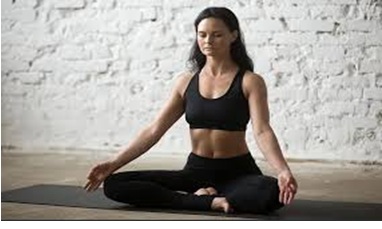
‘Kapala’ is a Sanskrit word; it means skull. ‘Bhati’ means to shine. The term “Kapalabhati” Kriya cleanses the skull. So this is taken as one of the Shat-Karmas (six cleansing processes in Hatha Yoga). Sit on Padmasana. Keep the hands on knees. Close the eyes. Perform Puraka and Rechaka rapidly. This should be practised vigorously. One will get perspiration profusely. This is a good form of exercise. Those who are well-versed in Kapalabhati, can do Bhastrika very easily. There is no Kapalabhati, can do Bhastrika very easily. There is no Kumbhaka in this Pranayama. Rechaka plays a prominent part. Puraka is mild, slow and long (Dirgha). But the Rechaka should be done quickly and foreibly by contracting the abdominal muscles with a backward push.
When you do Puraka, release the abdominal muscles. Some people naturally make a curve of the spine and bend their heads also. This is not desirable. The head and the trunk should be erect. Sudden expulsions of breath follow one another as in Bhastrika. To start with, you can have one expulsion per second. Gradually you can have two expulsions per second. To begin with do one round in the morning consisting of 10 expulsions only. In the second week, do one round in the evening. In the third week, do two rounds in the morning and two rounds in the evening. Thus every week, gradually and cautiously increase 10 expulsions to each round till you get 120 expulsions for each round.
It cleanses the respiratory system and the nasal passages. It removes the spasm in bronchial tubes. Consequently, Asthma is relieved and also cured in course of time. The apices of the lungs get proper oxygenation. Thereby they cannot afford favourable nidus (breeding grounds) for tubercle bacilli.
Consumption is cured by this practice. Lungs are considerably developed. Carbon-dioxide is eliminated in a large scale. Impurities of the blood are thrown out. Tissues and cells absorb a large quantity of oxygen. The practitioner keeps up good health. Heart functions properly. The circulatory and respiratory systems are toned to a considerable degree.
Draw the air through the left nostril till you count 3 OMS; throw it out through the right nostril immediately without retaining it counting 6 OMS. Stop it outside till you count 12 OMS. Then draw the breath through the right; exhale t through the left and stop it outside as before, exhale it through the left and stop it outside as before, using the same units of Om for inhalation, exhalation and retention. Do six times in the morning and six times in the evening. Gradually increase the number of rounds and the time of Kumbhaka. Do not strain or fatigue yourself.
Sit on Padmasana or Siddhana in your meditation room, before the picture of your Ishta Devata (guiding deity). Close the right nostril with the right thumb. Draw in the air very, very slowly through the left nostril. Then close the left nostril also with little and ring fingers of the right hand. Retain the air as long as you can comfortably do. Then exhale very, very slowly through the nostril after removing the thumb. Now half the process is over. Then draw air through the right nostril. Retain the air as before and exhale it very, very slowly through the left nostril. All these six processes constitute one Pranayama. Do 20 in the morning and 20 in the evening. Gradually increase the number Have a Bhava (mental attitude) that all the Daivi Sampat (divine qualities) e.g., mercy, love, forgiveness, Santi, joy, etc., are entering into your system along with the inspired air and all Asuri Sampat (devilish qualities) such as lust, anger, greed, etc., are being thrown out along with the expired air. Repeat Om or Gayatri mentally during Puraka, Kumbhaka and Rechaka.
Hard-working Sadhakas can do 320 Kumbhakas daily in four sittings at the rate of 80 in each sitting.
This Pranayama removes all diseases, purifies the Nadis, steadies the mind in concentration, improves digestion, increases the digestive fire and appetite, helps to maintain Brahmacharya and awakens the Kundalini that is sleeping at the Muladhara Chakra. Purfication of Nadis will set in rapidity. You will have levitation (rising above the ground) also.
When you practise the following concentrate on the Muladhara Chakra at the base of the spinal column, which is triangular in form and which is the seat of the Kundalini Sakti. Close the right nostril with your right nostril with your right thumb. Inhale through the left nostril till you count 3 OMS slowly. Imagine that you are drawing the Prana with the atmospheric air. Then close the left nostril with your little and ring fingers of the right hand. Then retain the breath for 12 OMS. Send the current down the spinal column straight into the triangular lotus, the Muladhara Chakra. Imagine that the nerve-current is striking against the lotus and awakening the Kunalini. Then slowly exhale through the right nostril counting 6 OMS. Repeat the process from the right nostril as stated above, using the same units, and having the same imagination and feeling. This Pranayama will awaken the Kundalini quickly. Do it 3 times in the morning and 3 times in the evening. Increase the number and time gradually and cautiously according to your strength and capacity. In this Pranayama, concentration on the Muladhara Chakara is the important thing. Kundalini will be awakended quickly if the degree of concentration is intense and if the Pranayama is practised regularly.
If you do concentration and meditation, Pranayama comes by itself. The breath becomes slower and slower. We all practise this Pranayama daily unconsciously. When you are reading a sensational story-book or when you are solving a mathematical problem, your mind is really very much asorbed in the subject-matter. If you closely watch your breath on these occasions, you will find that the breath has become very very slow. When you see a tragical story being enacted in the theatre or a film-show, when you hear a very sad striking news or some glad tidings, when you shed tears either of joy or sorrow, or burst into laughter, the breath is slackened-Pranayama comes by itself. In those Yogic students who practise Sirshasana, Pranayama comes by itself. It is obvious from these examples that when the mind is deeply concentrated on any subject, the respiration slows down or stops. Pranayama is being done automatically. Mind and Prana are intimately connected. If you turn your attention to watch the breath on those occasions, it will regain its normal state. Pranayama comes by itself to those who are deeply absorbed in doing japa, Dhyana or Brahma-Vichara (enquiry of Atma).
Prana, mind and Veerya (seminal energy) are under one Sambandha (connection). If you can control the mind, Prana and Veerya are controlled by themselves. If you can control Prana, mind and Veerya are controlled by themselves. If you control the Veerya by remaining as an Akhanda Brahmachari without emission of even a single drop of semen for 12 years mind and Prana are controlled by them. Just as there is connected between wind and fire (light), so also there is connection between Prana and mind. Wind fans the fire. Prana also fans the mind. If there is no wind, fire or light gets steady. Hatha Yogins approach Brahman by controlling Prana. Raja Yogins approach Brahman by controlling mind.
In this Pranayama you need not close the nostrils. Simply close the eyes if you practise it in a sitting posture. Forget the body and concentrate. If you practise this during walking, just feel minutely the movement of the air that is inhaled and exhaled.
Walk with head up, shoulders back and with chest expanded. Inhale slowly through both nostrils counting Om mentally 3 times, one count for each step. Then retain the breath till you count 12 Oms. Then exhale slowly through both nostrils till you count 6 Oms. Take the respiratory pause or rest after one Pranayama counting 12 OMS. If you find it difficult to count Om with each step, count Om without having any concern with the steps.
Kapalabhati can also be done during walking. Those who are very busy can practise the above Pranayama during their morning and evening walks. It is like killing two birds with one stone. You will find it very pleasant to practise Pranayama while walking in an open place, when delightful gentle breeze is blowing. You will be invigorated and innervated quickly to a considerable degree. Practise, feel and realise the marked, beneficial influence of this kind of Pranayama. Those who walk briskly,. Om mentally or verbally do practise natural Pranayama without any effort.
Lie down on the back, quiet at ease, over a blanket. Keep the hands on the ground by the side and legs straight. The heels on the ground by the side, and legs straight. The heels should be kept together, but the toes can remain a little apart. Relax all the muscles and the nerves. Those who are very weak can practise Pranayama in this pose while lying on the ground or on a bedstead. Draw the breath slowly without making any noise, through both nostrils. Retain the breath as long as you can do it with concept the process 12 times in the morning and 12 times in the evening. Chant Om mentally during the practise. If you like you can practise the ‘easy comfortable posture’ also. This is a combined exercise of Asana, Pranayama, meditation and rest. It gives rest not only to the body but also for the mind. It gives rest not only to the body but also for the mind. It gives relief, comfort and ease. This is very suitable for aged people.